Wednesday, October 9, 2013

Funland

One of the famous old landmarks in Miami was a drive-in theater. It was famous in later years as the only drive-in theater in Miami with air-conditioning! Really, they had flexible hoses you stuck in your vent window to cool off, or to defog the windows, depending on the level of activity inside the car. The 27th Avenue Drive-In theater was known as make-out central. With spaces for well over 500 cars, the drive-in was one of the most popular spots for submarine watchers and one-arm bandits in the northwest part of Miami. Cats from Hialeah and Miami Springs showed off their cool cars while the bunch from nearby North Miami and North Miami Beach, which, by the way, isn't on Miami Beach, did the same. Great place to go if you had a date, but if you were with a bunch of guys, looking for some action, Funland just up the road at the corner of NW 79th Street and 27th avenue, was supposed to be the place to go. That was also where the bad-asses hung out and gang rumbles had caused problems all summer long. But they had neat chicks, too, so we thought we'd see what it was all about. So, one summer night in 1960, we did just that.

Driving my dad's two-tone grey '56 Ford sedan, my brother Dean and I headed out to Westwood Lake on Miami's southwest border with the glades to pick up Jim Coleman and Wayne Horstkamp. Jim and Wayne were Civil Air Patrol cadets as were Dean and I, so we were pretty tight as friends. We were all on the squadron drill team, and had all flown together many, many times in the C-119 Flying Boxcars out of the old Air Force Reserve depot at Miami International Airport. We just loved to fly in those things, often making entire flights sitting in the cockpits. We thought we were cool.

We had all goofed off many times together, sitting at drive-ins along Bird Road, ordering as little as possible as we didn't have a lot of money. We didn't drive much either as we couldn't afford to buy gas. The car-hops always stayed away from cars filled with jerk guys, even though we were never foul mouthed or rude. We were just stupid kids having fun. One evening Horstkamp, sitting in the back seat, tried to throw a firecracker out the window at the car next to us, but the window wasn't down far enough and the lit firecracker hit the glass and dropped into his lap. It went off as he scrambled up the back of the car seat trying to get away. He didn't make it.

The night we decided to go to Funland was special. I had graduated from high school and was leaving for the Air Force soon, and we were in a reckless, adventurous mood. Jim, Wayne and I had been fishing on the Bear Cut bridge on the Rickenbacker Causeway earlier in the day, using a couple of pounds of shrimp my mom had in the freezer. We caught a few grunts and a couple of small snappers, nothing to keep, but it was fun. It was the last time I would fish for ten years or so.

The trip to distant Funland from southwest Miami was a long trip in those pre-expressway days, but this was going to be a special trip. Hey, we might meet some girls! Girls who didn't know us.

Funland was kind of a dump. More like a permanently mounted carnival than an amusement park, but they had a wild-mouse and bumper cars, even a Ferris wheel. It wasn't a big enough park to have a real roller-coaster, so the wild mouse was it. Arcades were spread around the park to give it the carnival atmosphere. The guys on dates all rode on the merry-go-round with their sweeties, eating cotton candy just like in the movies. Most of the juvenile delinquents just wandered around just looking for a fight. Wayne turned his collar up and started acting tough. We immediately reminded him he was the smallest one of us and would be the first one they jumped on if he started something. We ended up wandering around like everyone else, just watching the crowd. The crowd included some extravagantly dressed, apparently single, older women. Most of them just looked at us and smiled.

It didn't take long until shouting and fighting started on the far end of the park. A rumble was under way. We decided we weren't any kind of a match for zip-guns and switchblade knives, so we decided to leave before things got nasty. Too late. Sheriff's deputies had already set up a barricade at the entrance to the parking lot. We were stopped by several deputies and a tall, lanky older fellow in a grey suit and a white shirt and tie.

ID's were shown, names were taken, and then we were asked to take them to our car. They had several groups of boys waiting, but they were letting couples leave without stopping them. I guess we looked like trouble. Jim told Wayne they stopped us because he had his collar up. Jim was probably right, it certainly didn't help.

Just what I needed! I was supposed to report for induction in a few weeks, what if I got arrested! I hadn't done anything, but the cops weren't having any fun and they certainly didn't like us. They were downright nasty.

We walked to the old Ford and opened all four doors. The cops went through the glove box and looked under the seat.

“Open the trunk!,” the detective growled.

Obediently, I walked to the rear of the car and opened the trunk.

He reached in and grabbed the white-paper wrapped package, and I let out a grunt as I recognized what he had in his hands.

They all stopped and looked me as if I had given away the big secret.

He ripped open the package of dead, smelly, thawed out-shrimp, warm from having spent the day locked in the hot trunk of the car. He looked up at the deputy who had leaned over to see what they had found and started laughing. I told him I forgot they were there from our fishing trip.

“Get out of here!” He said, as the one cop told the others about their find. We could hear them still laughing as we quickly pulled out of the parking lot and started our long trip home.


Friday, June 28, 2013

Rain, Rain, Go Away!


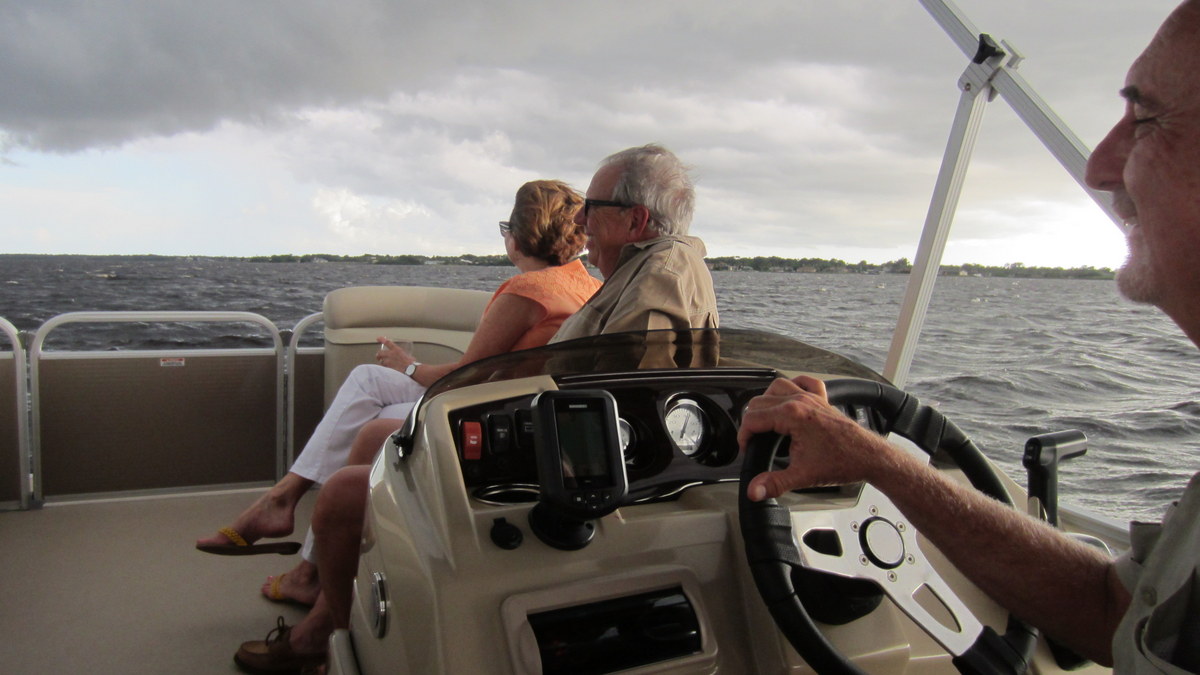
We invited friends who were visiting us for the first time to join us on our maiden voyage. It was the very first time we cast off from home since bringing the new 20 foot Bennington pontoon boat home. We were to have dinner with our first-time guests, but before we ate, I convinced everyone to join us for a thirty-minute cruise to the nearby river to see the beauty of our area. I even talked one of our guests out of changing her beautiful new shoes as I convinced her all she would do is sit on the new luxurious seats and drink wine!

I glanced at the latest weather radar before asking everyone to cruise with us, and saw a small weather blip way up north, headed away, so I thought we would be fine. As we left the dock, Ilse poked me and said, “Look back! Do we need to worry?”


Dark clouds were forming on the horizon behind us, but the river ahead looked clear and bright. I thought I could go to the river and turn down stream and head toward the State Road 776 bridge which passes over the Myakka River just in case the small storm decided to head our way. Besides, radar showed it going east, away from us so we shouldn't have to worry. We have parked under bridges in the past while Florida torrential rain poured down harmlessly on either side of us. I thought if indeed the storm expanded to cover us, we would be safe under the bridge.

When we reached the river some twelve minutes later, the storm clouds covered twice as much of the northern sky behind us as when we started out. We were still in sunshine, but the ominous clouds obviously were not headed away. They were coming closer. The storm was expanding. As we left the slow speed zone of the waterway and turned into the Myakka river, I opened the throttle as far as I safely could as I was only into the second hour of the break-in period for the new Yamaha 70 horsepower outboard motor. It didn't matter. I could have run full throttle and we would not have made it. 

With three miles to go to the bridge, I realized I had made a bad mistake. I have made this trip for the last fifteen years in a 21 foot, deep-vee Chris Craft powered with a 200 horsepower motor. The old boat would plane easily and speeds around 35 miles an hour were a piece of cake. We would have been there in a matter of minutes. Unfortunately, I was no longer driving the fast Chris Craft. Nope, the new pontoon is a party barge, a displacement boat powered by a 70 horsepower motor. It may get up on a plane, like a water skier, but it will never be fast, even if I put the 200 horsepower motor on it. After pushing as hard as possible for five minutes, I knew we wouldn't make it. As I looked back, the entrance to the waterway was already obscured by rain. Damn! No going back now!


Rain blanketed the bend in the river as I tried in vain to get there first. Rain began to come down in sheets, teasingly leaving our small section of the river as the only dry section before all you-know-what let loose. And it did, from all sides. Our little Bimini top was absolutely no help! The seas picked up to a foot and a half, which in the Myakka River is impressive, and heavy rain pelted us as if to say, “See, smart ass!” One of my guests, water dripping from his glasses, made a supposedly humorous comment about my overall intelligence.

No argument there. This was without doubt the dumbest boating decision I have made in the 58 years I've been doing this. As we headed back I tried to keep the boat aimed so the Bimini top offered at least some protection from the wind-swept rain, but that didn't work well either. Everyone was drenched! Absolutely drenched! Pontoon boats offer absolutely no protection from the elements, and Florida summer rain storms are brutal. The only possible solution is to carry emergency wet weather gear for every one, even if it is only cheap plastic throw away rain covers, and water tight containers for the shoes. In the future, I will carry wet weather gear for everyone.

The new boat handled well, water sloshing over the bow with alarming regularity. I throttled back to minimize the effects of the rough seas, and slowly headed toward the channel markers that offered sanctuary from the torrential rain. As I turned back into the slow speed, no wake zone waterway some twenty, soaking-wet minutes later, still doing at a pretty good clip, for a pontoon boat with six adults on board, the rain began to let up. By the time we returned to our dock, the rain completely stopped, the only water spoiling the surface of the waterway was dripping off the tree leaves.


With all our guests drenched, I worried if any of them would even talk to me. After drying off, and another glass of wine, they departed to change clothes, and forty-five minutes later, they returned and we began the dinner where we left off. No harm done, except my ego, and at least one pair of water-logged shoes.


Wednesday, May 22, 2013

Daisy


Daisy  1999 - 2013

Daisy was never an outside dog. She would only stay outside with us as long as it was cool and she could lay in shade, usually under the big live-oak tree next to the house. She would much rather lay on the living room couch in the air-conditioning. Even then she would pant.

She hated the Florida heat. With her thick, white coat, she was better suited for Norway or some other Scandinavian country that really was her heritage as she appeared to be a mixed Spitz/Samoyed type. She was a rescue dog, and even the veterinarians weren't sure of her main breed. Our daughter, Monica, found her on a highway in Georgia during a rainstorm in early 2000. Someone simply dumped one of the sweetest dogs ever alongside the road. Probably because she was pregnant.
Monica named her Daisy, and the name suited her perfectly. After taking her to a vet and getting her neutered, she became part of Monica's household, at least until we lost our dog, Sasha.

Having a pet euthanized is incredibly difficult. Watching a loved pet die in your arms is even worse, and that is what happened to our first dog, Tippy, a Beagle who died of kidney failure. Ilse and Monica did their best to comfort him and relieve his suffering, but it was incredibly difficult for both of them as they helplessly held him while he died an agonizing death.

We lost our second dog, Sasha after fifteen years. It was a difficult decision to make, and even a more difficult task to actually do. When Sasha, reached the point of being beyond help or recovery, we decided to have our veterinarian come to our house to end our fifteen year old mixed spaniel's difficulties. We didn't want to sit in any waiting room with our beloved pet, waiting for the inevitable nurse call and our veterinarian graciously complied.

It wasn't long after we lost Sasha that Monica called and said, “I have a dog for you!” We both said,

“No, it's too soon. We still miss Sasha and any new dog would just compete with our memory of her.”
“I'll send photos,” Monica said.
“Fine, but don't expect us to take her. We aren't ready.”


Daisy's first week at her new home was spent lying in the far corner of our lanai, simply staring at us. She ate without problem, and seemed to enjoy walking with us in the evening, but at night she slept in the living room with her muzzle on the low window sill. It took months before she began to show affection, but when she did, it was always on her terms. Nobody forced Daisy to do anything. Oh, she was well trained, she always followed commands, but as far as showing any kind of attachment, Daisy was a loner.

She rarely barked. She would announce anyone at the door, but that was it. We took her outside off leash after just several weeks, but we live on a waterway that runs into the Myakka River not far away, so we see alligators in the water behind the house regularly. We always checked the yard and banks before allowing her in our unfenced yard.


We found out she much preferred air conditioning to the fresh air of outdoors. She began sleeping closer to us, but only when she napped during the day. She was never aggressive. She could meet any dog at any time, and she would curiously say hello, then back away. Several years after we got her, she began to show signs of lethargy and lack of energy. She was diagnosed with a kidney problem that she lived with for years, and had a chronic thyroid problem that we gave her medicine twice a day to keep under control until the end. She also had the worst case of benign tumors of any dog our vet had ever seen. He took one off her side that required over twenty-five stitches.

Dad, I don't feel good...

One day while we were working in the yard, we noticed Daisy was laying under the Oak tree in a sphinx-like pose, looking down between her out-stretched paws. When we called her to come in, she looked at us, then looked down once again between her paws. Curious, we walked over to see what see was watching and were surprised to find she was protecting a baby squirrel. She would gently sniff it, then look at us as if to say “this baby needs help!” Daisy never barked in anger at anything, never once did we ever hear her growl.
None of her ailments stopped her from walking with us during the three months we camped across the eastern part of the country last year. She joined us on every trip, and walked hills and trails just like a young dog right to the very end.


Daisy on the Allegrippis Bicycle Trail, Pennsylvania, 2012

We ended up with a second dog, Taz, a Golden Retriever mix who was the opposite of Daisy in every way, but Daisy adored him and he became her pack leader. Taz is finally realizing something's wrong three days after Daisy's death, but we're not sure if he understands why. He hasn't gone looking for her that we know of, but he's a different dog. His fast, active demeanor is gone. He actually looks and acts depressed. He is finally realizing his sweetheart isn't here any more. 


Wednesday, March 13, 2013

Pithole Phyllis

Poor Pithole Phyllis can't even get her name in the paper. Her cousin, Punxsutawney Phil, grabs headlines every February 2nd down at Gobbler's Knob, but not poor Phyllis. No one calls to ask her anything. Great-great-grandpa Phineas made the mistake of picking the wrong town when he dropped off the back of the slow-moving buggy at the edge of Pithole, Pennsylvania, way back in the fall of 1865. He thought he had picked a town that had real potential. Oil wells were popping up everywhere since Colonel Drake drilled his first well over by Titusville, just a short buggy ride away. With fifty-four hotels, three churches, a railroad, the very first oil-pipeline, and even a red light district, Pithole had grown into a real city. Yep, ol' Pithole was on the map! Phineas decided to stake his claim and grow roots in this bustling metropolis.

“Whoa Nelly, is this gonna be fun!” Phineas thought to himself as he waddled across Holmden Street. “We even got us a theater and a newspaper,” he mused, then scurried as fast as his four short legs would go to get out from under the flailing hoofs of the horses being ridden wildly through town. He looked back from under the safety of first wooden porch he came to.

Early the next morning Phineas waddled to the top of the highest hill to see what he could see, but all he could see were oil wells! The forests were gone. Even the cow pastures had been torn up to build big, ugly structures that looked like they would blow down in a storm. By the time Pithole had 20,000 residents just a few months later, poor Phineas and his new family were stuck deep in the woods, terrified to venture anywhere near the farmers on the outskirts of town who would shoot at them on sight, or anywhere near the smelly oil fields where they would get covered in the dark, sticky goo that just wouldn't come off. Phineas was in despair, how could he have been so wrong?

His brother, Percy, had warned him not to be so impetuous. Percy stayed in Punxsutawney, some seventy miles further south. “There are only a couple of thousand people here in our little town, and that's all we'll ever have,” Percy told Phineas. “There's no reason on earth for anybody to ever move here! We'll never be bothered with traffic and noise. Stay with us and we'll all grow old and fat together, my brother.” But Phineas would have none of it and jumped up on a passing buggy axle the first chance he had. Percy never saw Phineas again.

Percy became something of a local celebrity in Punxsutawney. He always seemed to be where ever there was a fresh crop of sweet corn, and never missed a ripe garden that was within five miles of town. Life was good in little Punxsutawney. Percy was in the process of living to a ripe old age when he was caught off-guard by a freak blizzard one day in early February while trying to make his way slowly up to Gobbler's Knob. He saw his shadow that morning and decided sunshine meant good weather. He loved lying in the sunshine, and decided the top of the Knob would be a great place to soak up the warm rays of the sun. Unfortunately, like most groundhogs, Percy just wasn't very fast, and his old age made him even slower. He was too far from his burrow when the cold sleet of a late winter storm snuck in and caught him in the middle of an open field. Percy struggled desperately, but finally exhausted, he fell still in the winter snow and froze to death. Percy's oldest son, Phil, swore they would never again get caught off guard by the weather. Every year since, on the exact anniversary of Percy's fatal journey, Phil cautiously sticks his head out of his relocated home near Gobbler's Knob and decides for all groundhogs everywhere if they get to sleep in for six more weeks.

Phineas always kept abreast of his prudent, rational brother through the fuel of all envy, gossip. The polecat family that lived down by the hollow always seemed to know everything. Phineas heard about poor Percy, but he didn't make the trip for the funeral. He was too proud to admit his brother had been right, his dreams had been just too grandiose. Phineas's family eventually suffered just like the ill-fated town. Twenty years after moving to Pithole, the town was gone, only a blur in the memory of a few. Phineas never went back to the hill.

His family endured for generations after he passed away, but just barely. Most of his offspring departed for places unknown. Only a handful of grandkids stayed in the empty, cold family burrows, devoid of laughter and mirth. Every year on the day poor Percy froze to death, the current Punxsutawney Phil gets his photo on the front page of every paper in the country. Even Brian Williams raises his eyebrows to new levels to show Phil the 6th, or 7th, maybe it's now the 8th, being held aloft for all to see. Poor Pithole Phyllis waddles back to her den and pulls the covers up. The farmers still shoot at them, and if they aren't careful, they'll get run over by one of the few cars that travel down the usually empty roads. Groundhog Day just isn't very special in Pithole.


Monday, March 11, 2013

Mirror, Mirror


I look in the mirror and I see an old man's face staring at me. I wonder if he is as upset as I am about these things a doctor had to cut out of my chin. Those little stinkers weren't there last time I saw the dermatologist, just six short months ago. Or, at least they weren't visible then. They were masked by my beard, right at the chin line. The gray and dark intermixed beard colors masked a blemish that belied the unwanted presence of cancer cells. Once found, they had to to be evicted as soon as possible, sent immediately on their way to a lab for analysis. I don't want those microscopic aliens chewing on me any longer than possible. Thirty damn stitches across my side of my face. I look like I fought with Zorro and lost.

Ironically, I posted a quote by Alice Walker, 1997 Humanist of the Year, just before I had to have the surgery. She wrote, “What the mind doesn't understand, it will worship or fear.” Here's this microscopic creature that eats me alive from the inside out when its good and ready, and I can't do a thing about it. Apparently, we carry them around, incubating these adaptive little one-cell eating creatures until they have our body-map figured out, then they pop up and multiply rapidly in one of several different variations. But I'm fortunate, the ones that decided to pop up under my skin aren't the terrors they used to be. Not at least if I take them out now. Their nastier pack-brothers are still out there roaming around though, as are so many, many more of their unsavory relatives.

I don't understand them, and I don't worship them. I don't fear them, either. I don't like them, and if I knew how to stop them, I would. Wide brimmed hats are now the order of the day. I know I have to keep my head and especially my ears covered when I go out to play, along with a liberal application of chemical sun-screen. Why ask for trouble?

Anybody who still smokes is an idiot. Sucking those flesh-eaters through your lungs every chance you get might invite a few of them to pick a soft crevasse of your lungs and incubate for a few years. Try and get them out! Freedom? Freedom has nothing to do with it. Smokers are victims of good ol' American advertising. If you think cigarettes are expensive, wait until you get hit with your first prescription for chemo. You ain't seen nothin' yet!

Say, maybe we're going about this the wrong way! We should hire the advertising agencies to lure cancer cells out in the open. Given the right incentive, Madison Avenue would develop a marketing program to lure the little stinkers out into broad daylight! We might not be able to afford the advertising charges up front, but I bet given enough time, the marketing industry would figure out a way fake those nasty little guys right out of everybody's body. The cancer cells would march right out in the open to die and be happy about it. They'd think it was their right to do so. 

Saturday, March 9, 2013

Facebook


As a writer, I'm usually prepared to take heat for what I write. The six years I wrote a business Op-Ed column for the Charlotte Sun Herald thickened my skin considerably. I have been blistered for just about everything under the sun. Having a friend toss one of the barbs, however, is a new one. It is so frustrating when a good friend inadvertently sticks you in the butt, especially in public. My first reaction is to ask my friend, "WTF?" The smarter move, however, is to find why the failure to communicate happened in the first place. 

I know no one reads my material exactly as I write it. No one else in here with me as I type and review the thoughts that tumble out, usually faster than my fingers can find the right keys. I do my best to write exactly what I want to write, that doesn't mean whoever reads it, reads what I wrote. Not exactly, anyway. Like listeners who hear only what they want to hear, readers only read what they want to read. I often cloak my dogma in humor, and I am disappointed when the point of what I write is misunderstood. What really surprises me is when the reader responds with what they feel is an honest rebuttal to an argument I didn't make. Well, not intentionally, anyway.

I set myself up for this new problem by using Facebook. You can post photos of your friends and relatives as you wander around the globe for everyone to see. You can express your political views, as well. When you do, be prepared for rebuttal. People you once thought were friends will dump on you if they disagree with you as if you were having a conversation in the local sports bar. I've found there are “friends” on Facebook who are just plain rude. They can't resist telling you, and your family and friends, and everyone around the world, the error of your faulty thinking, and they will do so vociferously. They should stay on their own pages where they can freely post their own viewpoints, but they don't. They want to rain on your parade and they will if you let them. I don't want anyone dumping on me on my own web page, nor using my page to promote their beliefs. That's what the “unfriend” button is for, and I have used it liberally ever since the last two Presidential elections. But this posting on my Facebook page wasn't meant as an insult; it was merely an honest response to one of my blog postings I referenced on Facebook.

I'm tempted to remove the comment, but that would be at the expense of our long-time friendship. A rebuttal to the comment will have to be diplomatically crafted to prevent essentially the same reaction. On the other hand, I can't leave it as it stands as it is completely misleading to anyone who comes across it. I'll see if I can manipulate this article in some way as to convey my thoughts. Oil on the water, so to speak. But, then my friend will probably say he doesn't swim in that stuff and we'll be off yet once again..

The predicament does tend to take the fun out of writing. Well, for a while anyway. I'll be back. I just won't post anymore on Facebook. As Paul Simon famously sang in The Boxer, "A man hears what he wants to hear and disregards the rest..."


Thursday, March 7, 2013

My Memorial Service

My Daughter, Monica, and I at the American Cemetery in Hamm, Luxembourg, in front of the grave of Gen George S. Patton

My Memorial Service


I want my memorial service to be a book sale. I want my wife, or heirs who inherit the duty of executor, to put copies of my autobiography discretely around the memorial display, preferably close to an American flag, and my old U.S. Air Force uniform, which I want hanging on a wooden hangar on the left side of the display. My book, Confessions of an Old Liberal, in a tasteful white book jacket, will have to be unsigned, unfortunately, as it hasn't been published yet. My eulogy can be the forward to the almost factual book; short, concise and in the current marketing scheme of selling books, inflated as possible. Maybe they can just read from the jacket liner.

It may be difficult to convince whichever funeral home ends up with me to fend off the clergy who will try to claim authority over my soul. Funeral homes seem to have a divine link with local religious powers, giving them an inside track to grieving family members who are then led to believe without some kind of formal religious guidance, my soul may just wander around North Port looking for a way out.

I often wondered about the overwhelming number of Christians buried in the oversea American War Cemeteries. I visit the American War Cemetery in Hamm, Luxembourg, where General George S. Patton is buried, every time my wife and I go to Germany to see family. The cemetery is located not far from the Luxembourg airport.  An occasional Star of David breaks up the symmetry of the row upon row of crosses in the somber reminder of the incredible price America paid to free Europe. The cemetery in Bastogne, Belgium, is the same way, and so is the memorial cemetery just outside Liege. Where are the atheists and the agnostics? What kind of marker did they get? Or did they just get drafted a second time?

The religious powers added “Under God” to the pledge of allegiance when I was in fourth or fifth grade, and changed the law about headstones in all the U.S. Military cemeteries about the same time. Before the early fifties, fallen U.S. service men and women were buried with round headstones with inscriptions. After the religious pressure successfully lobbied Congress, the markers were changed to Christian crosses, the Star of David, and the Crescent Star. The Wiccan Pentacle was added only after a lawsuit by Americans United for the Separation of Church and State in 2007. If you are a veteran, your survivors can choose from among different symbols offered for your old style round headstone by the Veterans Administration, now including the option for “none.” But they don't have a marker for me. My marker would be a question mark.

Even though the club obviously isn't as exclusive as it used to be, apparently there are no agnostics buried in any American military cemeteries. So up in smoke I go.
As Willie Nelson says:
“You won't see no sad and teary eyes
When I get my wings and it's time to fly
Just call my friends and tell them
There's a party, come on by
So just roll me up and smoke me when I die”1
 
By the way, there will be no discounts on the book. I may be a liberal, but I'm still basically a Capitalist. Now's the time to yank on the heart strings. If the churches can do it, so can I.

George Mindling © 2013
1 "So just roll me up and smoke me when I die"  Copyright © 2012 Willie Nelson

Monday, January 28, 2013

The Tree Joyce Kilmer Never Met

“Out, Damn Stump!” I swung again, aiming the mattock at the only visible remnant of the Brazilian pepper tree I had cut down over thirteen years ago. I sweltered for hours back then, digging out the base of the huge, invasive pepper tree that dominated the walking path through my planned garden. The invasive Brazilian Peppertree is of the few trees the government wants you to take out, no permit needed! I was more than happy to oblige.

I dug to where I could stand in the trench around the tree stump up to my knees, but, try as I might, I could not budge the huge stump. I had used a chain saw to cut the pesky, unwanted tree down to size. It took me hours just to cut and drag away the limbs that spread over the path. The depth of the root system mocked me, no matter how deeply I dug around it. I dug, cut roots, and pried constantly, but to no avail. There was always an unseen root I couldn't sever to free the burdensome stump from its commanding location in the middle of my planned walkway.

After three days of digging, I stood in the trench around the firmly rooted stump, my shoulders even with the top of the visible remnant of the formidable tree. I could not break through the incredible root system that buried itself into Mother Earth as if to say, “We are one: you will not win!” Digging was simply not the answer.

I went to my garage and rummaged through my cans of chemicals, intent on killing this thing I could not defeat with an ax or a saw. But I would win, come hell or high water. I returned with a battery powered drill and a huge auger bit that allowed me to open the stump as a magician might open a window to another world. Mother nature never counted on Makita drills and human ingenuity. Or the ounce of pure weed killer I poured directly into the the circular wound I inflicted on my now defenseless adversary. One tap wouldn't do, I thought, boring five more deep holes into the trunk. Using an old kitchen funnel, each new avenue into the heart of the tree got a full load of weed killer. Now, I thought, we'll see who wins!

Every visitor's trip through our garden was prefaced with a warning not to trip over the stump that protruded defiantly in the middle of the path, receding ever so slowly each passing year. Rot finally weakened the stump. It actually moved when I kicked it. It took a half-hour of solid work to bust out all the old rotted roots, looking like a huge molar that needed a gigantic root canal. I filled my wheel barrow with dried, rotted roots, some as large as my thigh. I was left with a hole that belied the stubbornness and tenacity of the Peppertree that once stood there. No sign of the valiant struggle. I feel like I should commemorate the battle the tree put up in its fight to survive. Perhaps a marker of some sort, just not another tree. Especially not a Peppertree.

Thursday, December 15, 2011

Everglades Restoration Groundbreaking Ceremony

I didn't know what to expect as I waited in the parking area at the Homestead General Aviation Airport to board one of the chartered buses that was to take us to the Everglades Restoration Groundbreaking Ceremony that cool January morning in 1997. I read about the ceremony being open to the public, so I decided to drive down to and take a look at the future of the Everglades for myself.

Most of the people who boarded the bus seemed to know each other. Members of several service clubs and growers associations chatted among themselves as our bus drove back to Krome Avenue and then turned and drove down the dirt access road adjacent to the C-111 canal. I watched out the window as the bus made the short trip to the ceremony area, thinking it was about time something was going to be done to save Marjory Stone Douglas's wonderful "River of Grass." We disembarked and were directed to one of several large tents that had been set up not far from the waters edge on the other side of the canal. We walked across the road that was created by the pumping station to the large tents set up to accommodate the many speakers and guests. Even the Homestead High School Marching Band was in attendance. There were three helicopters parked discreetly behind yellow tapes back on the other side of the canal. I noticed that none were marked with television station logos. A nearby metal sign showed numerous bullet holes and dents.


The program started on time, but it didn't take long for me to wander out of the tent and away from the social/political scene. The ceremony was well into the speeches and remarks as I walked past the refreshment area and over to the canal bank. I was looking in the water at the canal's edge when two other fellows walked up, talking among themselves. One man soon walked back to the ceremony, leaving the other alone just a few feet away. He stood for a few moments, then reached down and pulled a few weeds from the canal bank, and tossed them one by one into the water. It was Dexter Lehtinen, the former U.S. Attorney who had first filed suit against the State of Florida in 1988 for allowing polluted water to flow into the Everglades. Lehtinen's suit, along with the thirty-nine additional lawsuits the original lawsuit triggered, actually began the legal actions that eventually led to the ceremony we were attending. It appeared he also would rather be fishing.

We started chatting about Florida and the Everglades, and finally about the Everglades ceremony behind us. He would occasionally glance back at the crowd to see if he was missed, but was far more content to toss weeds in the water. It was one of those times when the bus ride was worth it. Dexter's wife, U.S. Representative Ileana Ros-Lehtinen (who at the time was a State Representative) sponsored my daughter, Monica, to serve as her page for a week in the Florida Legislature in Tallahassee. We met the Lehtinens while giving our daughter her sendoff at Miami International Airport. He politely "remembered" meeting us, even though it had been ten or eleven years earlier. Shortly, others who had seen Dexter and wanted to say hello joined us, so I made my goodbye and slowly wandered back to the main tent in time to hear the Honorable Dante Fascell begin his speech.

The program had him listed as Mr. Dante Fascell, Esq. as he had retired from 38 years of service in the U.S. House Representatives some five years earlier. Somehow, after all those years, it just didn't seem right not to say Honorable. I listened intently as Mr. Fascell soon strayed from the political correctness that earmarked all the other speakers. He soon was talking to the people assembled in the tent as if we were all family. Everyone remembers him saying, "...seems to like to me we've been discussing the same thing now for about 50 years... There is only one way to get this thing done, and that is for everybody to work together...” Those comments are still heard today whenever Everglades restoration is discussed.

Mr. Fascell also reminisced about the flooding that swamped Greater Miami after the hurricane of the late 1940's. My uncle had told us about rowboats being used to pick up people during one flood, so I knew Mr. Fascell wasn't exaggerating when he repeated similar stories all over Miami. It was his duty to the people of south Florida to not let that happen again. He and others in political power implemented the legislation needed to protect the citizens of south Florida with a series of drainage canals and dikes. The resulting flood prevention construction by the U.S. Army Corps of Engineers was exactly the reason the Everglades had deteriorated to its present state. It wasn't done by accident or through stupidity. It was a deliberate plan to protect the citizens. It was, and remains a very effective flood control program. Now we have a different set of goals and ideals. While we can never restore the Everglades to it's original state, we can restore portions of it and reclaim much of its lost beauty while maintaining the safety of the citizens of south Florida.

I caught one of the last buses back to the parking lot, thinking maybe I should attend more of these government ceremonies. I had answers to questions that had been bothering me for years and had finally accepted the answers as something I would have done too, if that had been my responsibility. Besides, it was fun tossing weeds into the water, something everybody should do every once in a while.

George Mindling
Miami, Florida ©1998

[Author's update - July 20, 2018 - To put this in perspective, here is a photo of my brother Dean, on the left, and me, on the old Ingraham Highway to Flamingo, 1953.]


Saturday, December 10, 2011

I Envy Artists


I envy artists. You know, the people who put their talents, and quite often their very souls, right in front of you to see. You see their effort, their product, their thoughts and interpretations as they meant you to see them as soon as there are created or unveiled. I, however, am a lowly writer. My product, as individual and original as I intend, never gets to the printed page without someone altering what I create. When I use my fingers and my wit to translate my verbal image into a permanent record, no one but me see can see the original. Even the original is only a nebulous thought that often contorts and becomes a victim of intellectual metamorphosis. Sometimes an entire thought is swept away by a simple distraction, lost forever. Like the purpose of this paragraph! Seriously, I have often wished a thought could miraculously appear on my computer screen before I compound what I was trying to say! If I only had a paint brush!

Editors can say I didn't following grammatical protocol when I used the blue oil from my palette. It should have had more green than yellow because my color simply shouldn't look like that. That is regardless of the image I, and I alone, created, but they can not see because they have to focus their vision through the eyepiece of academia.

Maybe it is my shadowing. It simply can't be applied in the corners of my description because of some 18th century rule about gerunds, or infinitives, or some other idiosyncratic restriction that detracts from the image I alone want to portray. When Henry Alford wrote in his 1864 book, The Queen's English, he admonished writers from splitting infinitives. It is a good thing the writers from Star Trek weren't looking at the past when they wrote “to boldly go where no one has gone before.” And the restriction against beginning a sentence with a conjunction sucks, too! Sometimes my image only has one word! There! That blasts the idiom rule and the one word sentence restriction rather easily. Perhaps that is the problem. No one but me can see the image I create. Or is it, I alone can see the image I create? How do I get my image to you without corruption? How do I get it in print without being filtered, trimmed, or perhaps simply misinterpreted completely? If someone plays with an interpretation, alters it and makes it their own, it would be is as if every sculpture, every monument would have the corrections of a critic applied before you see it. Every statue would have a plaster patch stuck on somewhere. Every painting would be touched up, color corrected before being hung on a galley wall. In writing, the editor is the critic who controls the creative results that end up in front of you, the reader. I apply my creation to a mechanical medium and find immediately it must conform to certain constraints and limits.

Without an editor, an author has little chance in the literary world. You may purchase a work of art based on your tastes regardless of a critic's comments. As long as I have an editor, however, there is a chance you may not see what I saw. My image then belongs solely to me. Can I get it to you without sounding like an uneducated cretin? Certainly, but you have to like the box it comes in. And I didn't get to design the box. How I envy artists!


But now the World Wide Web offers a resource unlike any other in mankind's history. One that allows anyone with a computer and access to the Internet the ability to offer the electronic world pages of writing that can be read anywhere in the world at any time. Entire books are written, shipped and read all over the world without using a single piece of paper! The written products by-pass the editors and are delivered directly to the critics, the ones who read, or delete, what ever is available. Readers, bloggers, and down-loaders have become the de facto editors. Writers have a brand new medium! We even get to design our own boxes.


"I Envy Artists" was published in the "The Florida Writer" Vol 5, No. 2, 2011