Monday, October 10, 2022

The Flight Engineer and the Nose Wheel


The 76th Troop Carrier Squadron, 435th Troop Carrier Wing, based at Miami International Air Depot, had the distinction of not only hauling our Civil Air Patrol drill teams around the state for drill competitions, but they also got to fly all the cadets from the Miami area to the two week long encampments held annually at different Air Force bases. The first CAP Summer Encampment I attended was at Eglin Air Force Base in the Florida panhandle in July, 1959, and once again, we flew in a C-119G Flying Boxcar of the 76th Troop Carrier Squadron. With three cadet squadrons in Miami alone, one of which was the Miami All Girls Squadron, the competition between the drill teams was fierce, but this year, our Miami Composite Squadron II won not only the Florida state championship, but our regional drill competition held in Memphis as well. The summer encampment was scheduled just before we flew up to New York City for the National Drill Competition. 

Spending two weeks at the Air Force Air Proving Ground Center was a treat for all of us, watching, inspecting, and even sitting in practically everything flown by the US Air Force. Nothing, however prepared us for the flight home.

The long, droning flight from the Florida panhandle was uneventful. We never flew above ten thousand feet and most of the cadets took turns looking out the few windows that were not scratched or discolored, watching the Florida landscape slip slowly beneath us. The magnificent Florida thunderheads never interfered as we started the long approach from the Marco station on Florida’s west coast, approaching Miami over the Everglades. On the long, gradual descent into MIAD, the flight engineer climbed down out of the cockpit and casually looked out the window on one side, and then crossed over to the other side of the cavernous, square box of the troop compartment and leaned against a window to get a good look at the engine on the other side. The fabric troop seats mounted sideways along the fuselage walls were in the way, so he would lean between whoever was sitting there to see out the window. The flight engineers always checked for oil leaks from the powerful Pratt and Whitney radial engines on every flight, and sometimes before we started an approach to land. They always came down from the flight deck when the landing gear was lowered.

He was satisfied and climbed back up the short ladder on the left side of the front bulkhead and disappeared back into the flight deck. Not soon afterward, the huge wing flaps began to extend and the buffeting that accompanies their extension began in earnest. The huge main landing gear doors opened and the main landing gear began to noisily lower. The C-119 was unique as some of the passengers could watch as the huge landing gear assemblies extended downward right beside the passenger windows. Another unique feature of the C119 was it required almost full power to fly with all the drag of the wing flaps and exposed landing gear. Those who were in the Flying Boxcar for the first time always got quiet and you could usually see the whites of their eyes from anywhere inside the fuselage as the noise levels rose and power was applied to the big Pratt and Whitney engines. The whole plane would shake and vibrate. Us “old” cadets would usually talk heroically to the rookies but some you just couldn't console. Besides, you had to yell which didn't help matters.


The flight engineer, a dark haired young looking fellow, probably in his mid to late twenties, climbed back down into the troop compartment for a second time. The flight engineers usually came down to spot check the main landing gear, a routine task done for every landing. This time however, he couldn't mask his concern. He turned and squatted down looking at the center of the bulkhead in the very front of the compartment. The bulkhead had an access panel held in place with Dzus fasteners, the standard Air Force twist-lock type quick access fastener. In the center of the panel was a small inspection panel that allowed a quick check of the nose landing gear. When the landing gear was up, the huge double tires of the nose wheels were clearly visible from inside the cargo area. You could squat and look through the panel window and see the tread on the tires on the nose landing gear, folded compactly inside the fuselage just under the flight deck. That was the problem for our flight engineer: they weren't supposed to be there, at least, not when the pilot was trying to land. They should have been down and locked for landing. The adult members of our squadron began to look like the first timers. You could see the whites of their eyes in the dimly lighted compartment. We all had on the mandatory parachutes but only the cadets were excited about possibly having to bail out!

We hadn't changed course, still droning on directly toward Miami. We knew we were still over the Everglades west of Krome Avenue, but we knew we weren't too far out or the pilot wouldn't have lowered the landing gear. The flight engineer removed the panel and looked around inside the nose-wheel compartment. He backed out and stood up, grabbing a red painted D-Ring hanging just above the panel. The D-ring was on the end of a metal stranded cable which barely protruded into the troop area. It was the emergency gear release should the hydraulic system fail. He braced himself by putting one foot against the bulkhead and yanked the D-ring with all his might. He practically fell on the floor as the D-ring pulled off the cable, leaving our surprised flight engineer with a useless, red painted D-ring in his hand and the nose landing gear still firmly stowed inside the aircraft. He scrambled back up the ladder and almost immediately reappeared as if speed were of the utmost importance. We all watched, absolutely fascinated by the drama unfolding right before our eyes.

He had grabbed a pair of vise grip pliers from the flight deck, a type of locking pliers that can be adjusted for size and locking grip, and returned to the stubborn cable. Working to get a grip on the cable proved to be futile as attempt after attempt to pull the cable met with failure. Finally, with absolutely no recourse, he twisted the remaining Dzus fasteners and took off the main panel. He laid it off to the right side of the bulkhead. With the panel removed, we could all see into the wheel well from the troop compartment. The flight engineer took a deep breath and climbed into the wheel well, squeezing past the struts and braces that cluttered the opening. He disappeared from sight completely and all the cadets as well as the few adult members held their collective breaths.

It was a moment I will never forget. The flight engineer couldn't be seen, yet we knew he was struggling with no tools inside a dark, cramped compartment with absolutely no room. The droning was incredibly intense, yet none of us heard it. Suddenly, with an indescribable noise, the nose gear doors slammed open and the huge landing gear swung free. The inside of the fuselage was blasted by 150 mile an hour wind! Dress uniforms, carefully wrapped in plastic, hanging from the static jump lines that ran the length of the aircraft, blew all over the back of the airplane. I could see the landscape below with the nose gear fully extended, and our incredibly dedicated, unsung hero, bracing himself with one foot against the fuselage and the other foot against the other side of the bulkhead, inches from the gaping hole! Nothing below him but the Everglades some 2000 feet down. And he didn't have on a parachute! He couldn't fit in the wheel well with one on.

The young flight engineer slowly backed out of the wheel well, stood up and brushed off his pant legs. He climbed back up the short ladder while we sat in wind-blown awe. The landing was without further incident, even though we were followed back to Base Operations by an Air Force O1A fire truck.

He got a round of applause but I don’t think he heard it. We never even found out his name. We all disembarked from the aircraft, and waited on the apron, but we never got to meet him. He was probably busy filling out paperwork.

Friday, September 30, 2022

Ludwig and the Donkey


An image of the old farm just off the highway immediately popped into my mind as my wife and I turned sharply into the triangular courtyard at the bottom of the hill. The Bauernhof looked astonishingly familiar. The house was nestled between the highway and a small farmer’s access road that ran along the river. I drove past it every day for three years on my way to and from work in the early 1960's.

The farmhouse was just over a small bridge over the minuscule River Nims, which in North Carolina would probably be called a creek, but this is the Eifel region of Germany, and the small, innocuous river played havoc with the area just two years earlier with horrendous flooding. Luckily, our hosts for the next three weeks,  Ludwig and Walburga Pax, were spared any damage.


They were kind enough to let us stay with them as they had an empty apartment on the ground floor of the old, but completely refurbished farmhouse. The arrangements were made by other German friends of ours so we could spend time in Bitburg, Germany, my wife’s hometown. Bitburg Air Base was also home to the 36th Tactical Fighter Wing and the 71st Tactical Missile Squadron, my duty station for over five years during two separate assignments. Bitburg was made famous in May, 1985, by President Reagan's visit to a local cemetery that drew both praise and condemnation.

Our hosts were very cordial as my wife and I spent the first several days going and coming, shopping in town, sightseeing and catching up on old friendships. We also got to meet several people we had friended on-line, mainly through Facebook. Soon, Ludwig and Walburga invited us to join them in their garden patio for a glass of wine and we immediately accepted. They had just returned from Tirol in Northern Italy where they celebrated their Silver Wedding anniversary. They had arrived home the night before we got there. They were settling in as much as we were.

Even with my rusty German, bolstered by my wife’s translation skills, we were soon reminiscing about the old days when blue US Air Force trucks roared up the hill on their way to Bitburg Air Base, or further on to Idenheim, one of our two launch sites. The missile support area where I worked was several miles back up the highway in the other direction. The Pax farmhouse was directly adjacent to the two-lane highway that connected the areas. The traffic on the highway back then was sparse, usually local farmers headed toward Oberweis or the farming villages scattered in the area. Occasional Luxemburgers came across from nearby Vianden, but the parade of blue USAF trucks and transporters and the colorful big, American cars of the officers and sergeants who worked at MSA or the other launch site we had at nearby Rittersdorf were just as common as the black-on-white license plates of the local residents. In the several days we had been there, it was obvious things have changed.

The traffic was incessant up and down the hill. Trucks of all shapes and sizes from Belgium, Luxembourg, Germany and even France were common, and the license plates of the continual flow of cars and SUVs reflected the economic state of the European Union, which seems to be doing quite well. The traffic at night slacked off little but the Pax’s newly rebuilt apartment had soundproof windows and window shades that insulated us completely from the outside world. While we were chatting about the differences between now and then, Ludwig laughed and told me about the day an Air Force truck brought him a donkey.

I sat up. Again, old memories began to stir. 

Sometime during the late 1950's, while the TM-61C Matador was the primary weapon system of the 585th Tactical Missile Group, MSA was developed as the off-base maintenance area and the nearby Site VII was then known as "B" pad. Ludwig’s parents rented the apartment on the ground floor of the farm house to an American missileman who often brought candy or gum for Ludwig. One afternoon the renter was talking with Ludwig's father and asked Ludwig, who was six or seven at the time, if he wanted a bunny, a chicken, or a donkey. Young Ludwig said he’d rather have a donkey. 

Several days later, a blue Air Force truck pulled into the farmyard towing a trailer. Several airmen opened the trailer and unloaded a donkey, complete with a box of feed and blankets. The American had asked Ludwig's father to house-keep the donkey for the Air Force, but Ludwig had no idea of how or why. Ludwig said he was very happy to get the Donkey.

I sat and listened to his story, my mind furiously spinning. I remembered posting a photograph on my web site of a donkey that had been brought back from Libya as a squadron mascot.  It was taken from a squadron newspaper clipping in the late fifties and I suddenly remembered where to find it. I went inside and logged on to Ludwig’s W-lan – it’s not called WiFi in Germany – and pulled up the photo of the donkey. When I showed it to Ludwig, he was speechless. He went inside and came back out with a photo of him sitting on the donkey! Now I was speechless.

Ludwig Pax, about 5 or 6 years old, with his mother
Photo courtesy of Ludwig Pax

A Martin Company civilian named Bill Baily accompanied the 71st Tactical Missile Squadron to Wheelus Air Base in Libya as a Technical Representative during a live-fire exercise done annually by all of the tactical missile squadrons assigned to NATO. The exercises, called AMLO, or Annual Missile Launch Operation, were done from 1954 through early 1959, with thirty-six Matador missiles launched annually at an area sixteen miles from the Wheelus flight line. While on the 1959 exercise, Bailey somehow acquired a burro from a Libyan local near the launch area outside of Tripoli and managed not only to get it on the C-119 flight back to Bitburg, but also got the Squadron to adopt the animal as its mascot. Renamed to Mahl Ish from whatever it was called before, the new name supposedly reflected the phrase “mox nix,” the military bastardization of the German phrase “machts nicht,” roughly translated as “doesn’t matter.” Someone even had a blanket made, probably in Libya, with the burro’s new name across the top and the squadron insignia proudly emblazoned in the center. It would be hard to imagine the 585th Tactical Missile Group commander, Col Fred Vetter, wasn’t in on the stunt as 1st Lt. Sherman J. Uchill was assigned as Mahl Ish’s custodian.

Ludwig did not remember the name of the American family his father rented to, but he remembered when the Air Police – since renamed to Security Police – knocked on the farm house door one afternoon asking to speak with the American renter. The tenant produced documents about the burro that satisfied the police and they left, leaving the burro with the Pax family.

Ludwig remembered having the burro for several years, with the Air Force coming by every once in a while to pick up the animal for special events, but they always brought the animal back to the farm. He also remembered the burro getting out of his pen more than once, one time going all the way to the main street in Bitburg before Ludwig's father found him.

Ludwig doesn't know the fate of the burro, only that one time the Air Force picked up the burro and that was the last time he saw it.

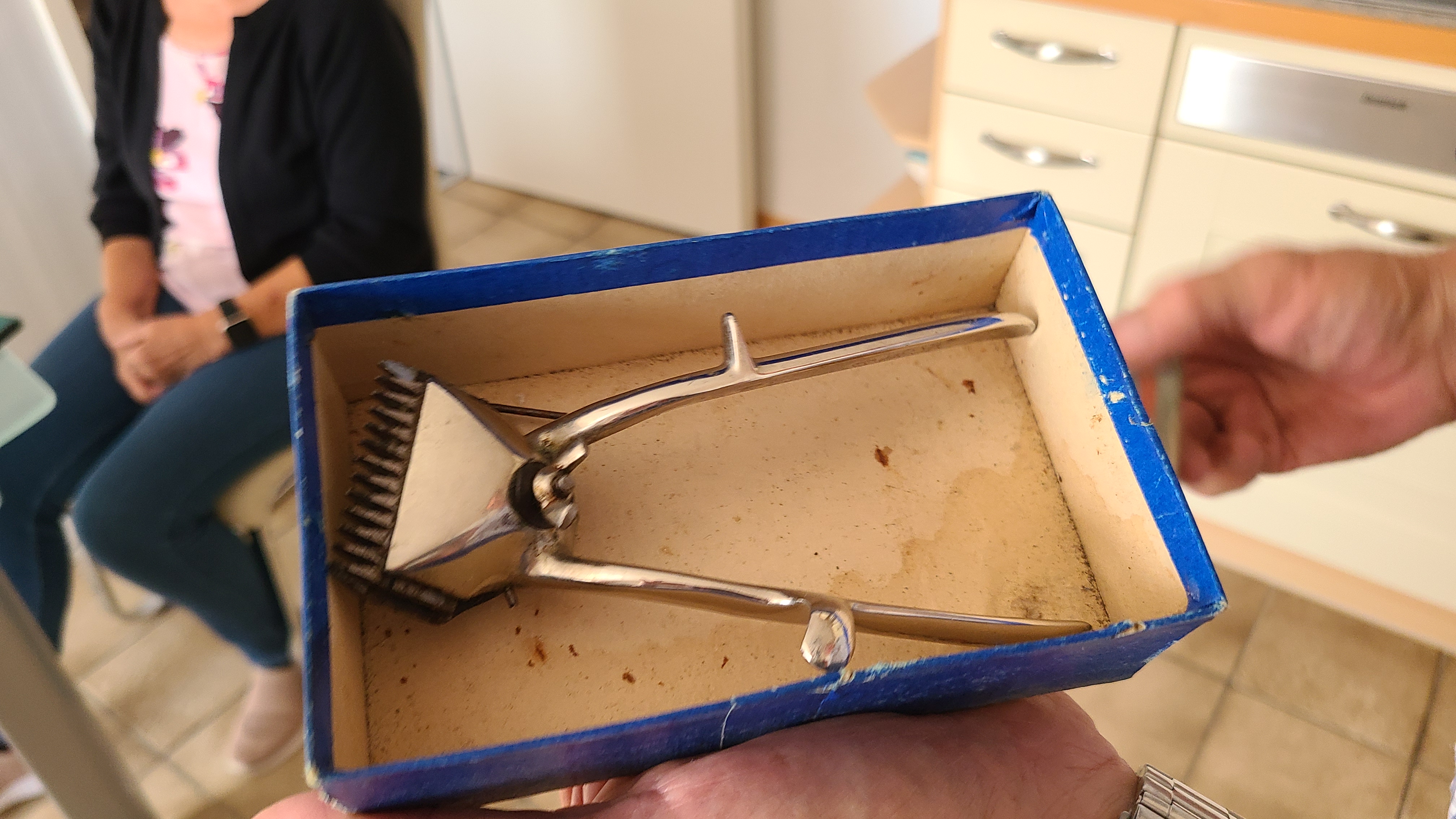
Not only does Ludwig still have the shears used on the burro...

...he also still has the original box it came in!

Both photos courtesy of Ludwig Pax


Determined to fill in the blanks after we were back home, I asked Russ Reston, webmaster for the TAC Missileers Association if he could put a blurb on their site asking anyone for information about the mysterious squadron mascot. He put my odd request on the Web page and the next morning I had an answer from Mike Fedrick, a missileer who served with the 585th TMG from 1959 until 1962, the year I arrived in the group.

Mike wrote “I was in the 71st TMS from 1959 to 1962. The donkey was brought to Germany from Libya in 1959 by the last group to go to Libya for combat ready launches. The rest of us went to Cape Canaveral for launches.

“I got to know the donkey up close and personal. When the 585th Tac Missile Group had a summer picnic for dependent children, the group commander (Col. Vetter) had me pick it up from the German farmer that was taking care of it, load it into a weapons carrier, take it to the picnic, and lead it around with kids riding on it, load it back, and take it back to the German farmer. My memories of this event are unpleasant because the donkey did not want to get into the weapons carrier, both when I picked it up and when we had to load it to take it back. The German farmer got it loaded the first time, but it took several of us to load it to take it back.

“I was told I was chosen for this onerous task because I’m from Texas. I’m actually good with horses, but never had to deal with a donkey before or after. As you know, Mox Nix means "makes no difference".

“Best regards, Mike”

I have no idea what strange stories will pop up next time we visit Bitburg, but it will be hard to top meeting Ludwig and hearing about his donkey.

George


Ilse Mindling, Walburga Pax, Ludwig Pax, George Mindling
Steinebrücke, Bitburg, Germany, September 2022


Sunday, November 14, 2021

State of the Art - Manga, Manga


I was bewildered after my wife and I walked into our local BAM this afternoon. Yes, BAM, and therein lies a hint the message on my brand-new T-shirt is painfully accurate. My wife’s new 79th birthday gift to me has “It’s Weird Being the Same Age as Old People” printed boldly across the front.

BAM is the new, hip, catchy name of what used to be Books A Million. That name change took place well before COVID so I’m just making excuses here, but what is new are the third, fourth, and five aisles of the store labeled FUNKO and MANGA. In the distance, I saw BUSINESS and COMPUTERS sections so I knew I wasn’t in a grocery store by mistake.


There must have been several thousand titles in the MANGA section, along with several groups of teenagers chatting and comparing books. I stopped a clerk working several aisles over and asked her to please bring me up to the twenty-first century. She adjusted her face mask and led me back to the FUNKO section.


“Looks like a toy store, doesn’t it?” as she waved her hand along shelves filled with plastic characters and avatars from a distant universe. “They’re supposed to be collectibles,” she said. “They sell pretty well, I guess.” She turned to the two full rows of shelves behind us marked MANGA. “At least these are books, sort of.”

“What genre are they?” I asked. The teenagers stopped chatting and looked at us as if we were infringing in their domain. One group moved to the end of the row of shelves. I think the clerk smiled behind her COVID mask, at least her eyes sparkled as if she was smiling. It is a young person’s style,” she said as she pulled a book off the shelf and handed it to me. “It isn’t for everybody.”

“Oh,” I said as if I knew what I was talking about, “It’s Y-A, Young Adult!”

“Not really,” she answered. “They’re picture books.”

I thumbed through one book, and then another, stunned by the graphic, pen and ink art panels with minimal or no dialogue printed anywhere. They looked like comic books in 6” x 9” format. The books seemed to be in sets, with one title having fifteen or twenty subsets. There are thousands of them.


“I’m stunned. I had no idea this type of book even existed.” I said

“Well, it is one way to get kids to read,” she said as she walked away. “Look on the wall across from us, there is another type of book in the same style over there.”

The whole back wall behind us was a sectioned labeled “Graphic Novels.” I thumbed through several of those as well. The only quick difference I saw was they were printed in color instead of black and white.


I thought the birthday T-shirt was cute, but now it reminds me of an old sweatshirt my mom wore that said “My Go-Go got up and Went-Went.” I have a feeling my go-go got up and went-went just about the time they renamed he store to BAM.

https://www.nypl.org/blog/2018/12/27/beginners-guide-manga#:~:text=Manga%20is%20an%20umbrella%20term,only%20used%20for%20special%20releases.

Saturday, October 23, 2021

College football in Florida


Disgusted, I turned off my TV and decided to find out if my next door neighbor was watching a College football game. Of the four local channels I get over the air on the “Big” four local networks, I could only find games like Slipstich U vs Podunk St. from somewhere west of the Mississippi.

My neighbor was busy making noise and sawdust, but he turned off his sander when he saw me walk into his garage.

“Hey, man, what's up?” he asked, lifting his sawdust-framed glasses so he could see.

“Do you watch Saturday college football?” I asked.

“Nah, man my son goes to UCF in Orlando and my daughter graduated from USF in Tampa. They don’t show those games here in southwest Florida.

“Yeah, I know,” I answered. I’m from Miami and they don’t show any of our games here either. They don’t show anything from the Canes or FIU or even FAU in Boca. They don’t even televise any of the conference games, the SEC, AAC, ACC or Conference USA.

“Well, you know,” he answered, “They cater to the snowbirds, even if they aren’t here yet. They show college football games nobody locally cares about. Maybe it’s cheaper that way.”

“In the old days at least we got to see the Gators or the ‘Noles, but they don’t even show those anymore.” I answered. “By the way, do you know anybody from Utah or New Mexico?”

“Nah, Why?

“How about El Paso or Iowa?” I asked.

He laughed and pulled his glasses down. “Why do you think I don’t watch Saturday College football?”

“Later, Man!”

The sander drowned out any lingering conversation. Maybe YouTube on the Internet might have something to watch.


George Mindling

Port Charlotte, FL


Wednesday, September 1, 2021

​Fooling Mother Nature


Anytime I see a writer use initials instead of a full name, I assume the writer simply doesn’t want to be categorized by gender, a practice used for many years by women who didn’t want to be excluded or belittled by a male-dominated industry. According to C.W. Hawes, writing in Tag: Writing for Men, “Male readers prefer, for the most part, the genres of adventure, humor, horror, and science fiction. They also tend to shy away from books that are focused on relationships (such as romance).” 

I assume C.W. is British as he/she uses the term “throw a spanner,” which few Americans understand. (spanner is a British term for an open-end wrench). Many male Americans my age can sing the lyrics to Dire Straits’ Industrial Disease without knowing what was thrown, but is that a sign men don’t read? Maybe they just don’t read what women read.


Spanner in British English, Open End Wrench in American English

First, C.W. Hawes is male, and second, he is not British. Born in Ohio, he now lives in Texas. I have no idea why he used the term "spanner" instead of wrench, but I’m sure it fit the need. When Joanne Rowling published her first book, the publishers decided to use initials instead of her real name. This was to disguise her being a female so the Harry Potter novels would appeal to a young, male audience, who the publishers had decided would be the primary market. Joanne is now known to the entire world as J.K. Rowling. Many of her readers do not know her first name.

“For most of history, Anonymous was a woman,” wrote Virginia Woolf. So, have we gone half-cycle? Do male authors need to use abbreviations now just to get an agent to call back? One of my favorite writer’s magazines - yes, I have a subscription – lists a current issue’s article’s authors as: Jera, Catherine, Kara, Sharon, Whitney, Amy, Cassandra, Barbara, Estelle, Sadie, Kristie, and Robert. That's ten to one against male writers. What's the opposite of misogynistic?

I don’t have the figures for the book publishing universe about gender diversity, but the realm of writing, editing and marketing has flash-banged into a new reality. I wonder how Tom Clancy would have broken into the Best Sellers lists if his books about submarines and warfare had been universally seen as insensitive or unemotional, basically considered unmarketable in today’s writing environment? Kind of smells too much like machine oil and grimy hands for today's book buying public?

I really think if a man had written Fifty Shades of Grey, he’d have been physically accosted and emotionally assaulted until he “crumbled asunder” in front of the “Me, Too!” movement. A man would have had to have hidden behind his initials just like the women used to do... Oh, wait a minute! E. L. James wrote the now famous, blog-inspired, self-published phenomena that jumped not just to the corporate publishing world, but the movies as well. Erika Mitchell, E.L James’s real name, just threw a wrench into the works. Or was it a spanner?

:)


Thursday, August 12, 2021

​Our “American” History - The Patriot's Tour


We started our “Patriot’s Tour” in Charlottesville, Virginia, originally planning on seeing James Madison’s estate at Montpelier first, but it was closed when we arrived, so we decided to drive the short distance to see Thomas Jefferson's Monticello instead. Monticello, the nationally revered plantation home of Thomas Jefferson, one of the creators of our Constitution, and third President of the United States was next on the list. We were following the American Revolution and the great thinkers who founded our country. I always had this trip in the back of my mind and we finally had the opportunity to wander through Virginia at our leisure. Unfortunately, Charlottesville is also the center of the American rebirth of blatant racism which blossomed under President Donald Trump just a few, short years ago. The irony wasn't lost on us.

Monticello isn’t a National Monument open to the public as is the Smithsonian in Washington. While it isn't Disney World prices, it certainly makes one wonder if there are musical rides and talking robots waiting in the corridors ahead. There is a sliding scale for entrance to help alleviate the financial cost depending on what you want to see. While we expected nominal entrance fees, my wife and I were surprised with the cost to see such a “National” treasure. The price of a forty-five minute guided tour of the main floor – and the basement of the homestead – was inconsistent with what we have experienced at other historic sites.

https://www.monticello.org/visit/tickets-tours/monticello-pass/

It appears to be an excursion into history reserved for the more affluent. According to their website, the attraction is run by “Thomas Jefferson Foundation, Inc., which owns over 2,500 acres of Jefferson's 5,000-acre plantation. As a private, nonprofit 501(c)3 corporation, the Foundation receives no ongoing federal, state, or local funding in support of its dual mission of preservation and education.” There are extra costs to see the second and third floors, and additional costs to see the gardens. We simply felt like we were being taken advantage of using our patriotism and desire to immerse in our history to their financial profit.

In a moment of enlightenment, Ilse and I decided to visit the where General Robert E. Lee surrendered the Army of Virginia to end the Civil War. We decided to head south to Appomattox, the symbolic location of the end of slavery in the United States. Slavery, the economic system that supplied most of the free labor that sustained the plantation style of the Confederacy, was defeated and the Union was saved just a little further south of our planned trip.
 
Our journey south started innocently enough by simply asking Waze how to get there from where we were, and had the pleasure of one of the nicest drives of our vacation as we headed down the four-lane divided highway toward Lynchburg. Highway US 29 was a pleasant, easy ride and I was minding my manners, toodling comfortably along in the right lane with a Virginia State trooper just behind us, when I was abruptly informed by our guidance system to turn left in three hundred feet. I waited until the trooper went around us and we made our turn into unknown territory. Why are we taking State Road 739 and where does it go?

When we came to the one-lane railroad underpass that had a sign that read “One way traffic - Blow your horn!” we knew we were in rural Virginia. I was glad we weren’t towing our travel trailer as we slowly proceeded under the old railroad bridge when my muse tapped me on the shoulder - she pops up whenever she wants me to pay attention and asked, "Is this the actual railroad that US Army General George Custer captured, the one the desperately needed Confederate supply train was on, that altered the course of the war?" 

The next thirty miles or so of twisty, backwoods, two lane road was a slow-motion thrill. The beauty of the area, and seeing the cleanliness and pride of the residents is worth a trip of its own. But, soon, I needed gas.

We pulled into the town of Appomattox and drove past the gas station I wanted. We doubled back to fill up the gas tank. It isn’t a busy place. We checked our road map – yes, I use one religiously - and compared the local road signs that seemed to point off somewhere in that direction over there somewhere… and decided to go that way.

After one stop at a memorial marker on the top of a hill, we saw the main park entrance a half-mile away.

That's where the U.S. Park service recreated the Appomattox Courthouse and the surrounding buildings in 1964. The original buildings were burned down some thirty-five years after the end of the Civil War, but by whom is still considered a mystery. It seems to fit the time frame of the pinnacle of power of the resurgent Klan which continued well into the twentieth century. Today it is called the Ku Klux Klan, but at its height of popularity forty years after the surrender at Appomattox it was simply called the Ku Klux. 

The location at Appomattox is authentic and the buildings have been rebuilt. The old stagecoach road has been isolated and maintained as it once was. I’m sure the buildings look better than they did in 1865, but they only symbolically portray the image of the four-year long war’s conclusion that was unexpectedly thrust upon them in a world-shaping event.

Missing from the Appomattox historic site is the soul. I had no feeling of wonder there. The buildings are freshly painted and properly maintained and the grounds are immaculate. The Crepe Myrtles flower beautifully along the parking lot, but there is no overpowering feeling of remorse or sorrow, joy or triumph. It is simply there. The heart was burned out by the white supremacists whose grandchildren marched four years ago in Charlottesville.

There is a gaping hole in our identity that we have yet to heal. It will take more than new buildings and fresh paint. We were awakened to the cruel reality that slavery slowly and methodically has morphed before our very eyes into a sadistic, vengeful retribution of defeat known today as white supremacy.

Perhaps Appomattox isn't really that far from Charlottesville after all. 


Friday, July 16, 2021

Appalled


(Written 7-30-2015)

Whoever thought a 72-year-old, white American male would be appalled at the thought of an innocent, unarmed creature being lured, even taunted into a gruesome, unnecessary shooting death by a white, armed hunter? It is a huge business to prove you're manhood and trophy rooms around the world brim with grotesque proof of its acceptance.

Well, I am appalled. I don't understand the reaction of the rest of the world. Suddenly, the world erupts and everyone mourns a lion lured to its death just to satisfy someone’s ego. When Walter Palmer, a dentist and recreational hunter lured a thirteen-year-old lion out of a protected animal preserve to kill it with a bow and arrow, the world erupted in protest. 

But oddly, eerily, no, the word is appallingly, the death of seventeen-year-old Trayvon Martin, walking home from a store, also lured and taunted by an armed adversary he didn’t know was stalking him, was not nearly as revered. 

His murderer, George Zimmerman, was found innocent of luring Trevor to his death. 

Maybe if Cecil the Lion had been a black lion with a hoodie instead of the typical King of the Jungle type, nobody would have cared. Just like they don't care about Americans killing innocent, unarmed blacks daily as if it were a field day. I am appalled. I am really appalled.


​Cloaks


I was introduced to a neighbor's rather slovenly son not too long ago, who, within two minutes, told me he was an ex-Navy Seal. My Air Force veteran’s fib detector went off immediately. He had no idea I was an eight-year, active duty veteran. I immediately assumed he had applied for and been denied, or even washed out of the special weapons training program, but it was highly unlikely he ever made it to any combat unit.


Of course we didn't call it a "fib detector" in the military, it had a more cynical name based on a great ingredient for growing mushrooms. It hadn't gone off that loudly since 2012 when some barfly in Wildwood, Florida, told me he used to fly the airplane we were removing from in front of his American Legion post. The “airplane” he supposedly flew was in fact an unmanned Mace cruise missile, one that I worked on for eight years. 

My BS detector, sorry, fib detector, has had quite a work out over the years since my discharge, and I've watched real veterans unmask the fake heroes time and time again. That nonsense does not impress real veterans. Almost all of the ones I know and worked with  are cloaked in one way or another, usually undetectable to most civilians. The signs, usually small, discreet, sometimes indiscernible medals, patches or ribbons worn only on dress uniforms or maybe on a suit lapel. 

The aircrew members, fleet commanders, weapons mechanics, launch officers, submariners, anyone who sat at a control panel with millions of tons of explosives literally inches, or seconds, away from their control, were cloaked then, and most still are. They were cloaked by security procedures, and often by political situations as well. They sat in silence, often in boredom, minute after minute, hour after hour, day after day, shift after shift, startled, often terrified, when the klaxon horns went off. 

They did it for almost thirty years while cities, military bases, naval ports and airbases were dialed in as targets for the nuclear missiles that sat sixty feet above them or behind them. Are we practicing destroying the earth or our we really doing it this time? Is this real or another exercise that will stop just short of an actual launch? Did the Soviets really invade West Germany or did China roll into South Korea? Is Japan under attack or are we just pretending once again? You know, for practice.

Our nuclear power, not only at home but in Europe and the Far East as well, was the only possible way for us to offset the numerical superiority the military forces Communist regimes had aligned against us. Don’t believe me? You are among the many Americans who suffer from amnesia or naivete. You probably believe Captain American will sweep down and save us from malignant adversaries set on destroying our country. No, it was the guy next door. He wore a cloak then, and most likely still does today. Most who wore the cloak knew they would kill millions of people if the war order came. People they would never see.

Do they still wear the cloak? Your neighbor who proudly boasts he was a Navy Seal or a Green Beret or a Ranger? Probably not. More likely your neighbor is wearing the invisibility cloak inside out so it shimmers with glory. Forty years ago all the wannabe heroes I met while I was in the service were “Green Berets,” even though the majority of the braggarts I met didn’t even know what an MOS was. No, I’m not going to tell you except in the Air Force it was called AFSC and in the Navy it's your rating. Today, thanks to media suffocation, most of the wannabes claim they are Navy Seals, even though you can tell by looking many of them couldn’t swim across their own bath tubs. Real Navy Seals cringe and the old timers just smile.

The people who won the cold war sit next to you in restaurants and shop with you at Walmart. But you don’t know who they are and probably never will. They still wear the cloak. They wear it the way it was meant to be worn, not inside out. They don’t tell you what their job was.

You cannot conceive what the cloak-wearer’s finger tips represented to mankind. The first time a live nuclear weapon was delivered to my unit’s first operational launch bay, the launch crew Non-Commissioned Officer in Charge (NCOIC), who had trained with the same launch crew in the United States at the Tactical Missile Training School in Orlando and practiced for over a year with his crew on site, broke down and cried. The operation was suspended as the maintenance and launch crews watched in stunned silence. Would the powers-that-be-pull the whole crew, or would they proceed replacing the only the overwhelmed crew chief? The operation was briefly interrupted, but soon finished by the book. It only took minutes before the entire crew adjusted and the insertion was completed.

There are the Cold Warriors you didn’t know were cloaked until they unexpectedly let it slip. It is understandable. They served every corner of the world the United States had military bases or Naval Fleets. Many units weren’t even acknowledged, such as the 498th Tactical Missile Group on Okinawa. Secretary of Defense Robert McNamara ordered the only Air Force nuclear missile unit in the Far East not be identified by name, only its initials.

I think that cloak today is nothing more than a revelation of our American society.

It is those veterans who did, and those who want everybody to think they did.


Sunday, July 11, 2021

Of Puppies and Purple Skin

Not all of my skin is purple, just the parts exposed to the sharp, little teeth of our daughter's new four-month old puppy. The skin on my arm is not normally purple, I’m just incredibly sensitive to bruising and scrapes, a condition that comes with age. My wife, who also suffers from the same process known as “aging,” calls it “onion skin.” All it takes to turn our skin purple is a four-month old puppy that is a lot faster than we are.

I tried to convince myself I am as physically capable now as I was just a few decades ago. I know it isn’t true, but I do my best to maintain the myth that old age is just a state of mind when I know full-well that my daughter’s puppy has made our arms and hands look like we suffer from a major skin disease. Besides, their reflexes make us look like we move in slow motion. The puppy probably thinks I am just another wiggly chew toy that squeaks. The louder I squeak, the more fun it is to chew!

I gave up climbing on the house roof a few years back when I realized I couldn’t swing my legs around the aluminum ladder to climb back down. Insecurity swept over me as I stood holding the ladder looking at the grass some twenty feet below me. I carefully, slowly, finally got a secure step on a ladder rung and climbed back down to reality. 

Gone were the natural abilities from when I scampered up a narrow cylindrical, forty-foot long aluminum fuselage, only forty-four inches across, mounted at a seventeen degree angle in its launch bay, in dim light with an Air Force tool bag in my hand while wearing combat boots. Gone was the inherent sense of balance, the quickness, the absolute confidence that falling wasn’t going to happen.

I knew damn well I was about to fall off the roof, though. I remember thinking “If I get down from here in one piece, I’m not ever going back up another ladder!” Believe me, aging isn’t just a state of mind. My mind knew I was in a precarious situation that I had sorely underestimated. To paraphrase comedian Flip Wilson, I let my ego write a check my body couldn't cash.

Taz was a seventeen-year old Golden Retriever that had been a real test for us when he was only two years old, but our arms never looked like we rolled around in barbed wire. He was our last dog, and while we miss all of our wonderful dogs, we have decided not to add any more to our family. All our dogs developed into wonderful companions, each with its own personality, to become real members of our family. We know our daughter’s puppy will do the same for them.

Someday, in a weak, quiet moment many years from now, long after the latest cute bundle of fur has passed on, they’ll probably say, “You know, we need a puppy…”

They may not have arthritis by then and maybe they might still be climbing up and down ladders. There is however, a real, real good chance they’ll get purple skin.


Friday, July 9, 2021

Writer Identification Guidelines

I’m always looking to improve my writing, so I downloaded a free writer’s guide advertised on the Internet as essential to succeeding financially as a writer. Financial success at my age is mainly based using coupons and careful redemption of my credit card bonus points. I’m retired and have no Pollyanna dreams of a garage full of Lamborghini's just because my muse brilliantly nudges my fingers around a computer keyboard. I may be the only reader who enjoys my writing, but then all authors enjoy their own writing, I write compulsively and continuously, I just don’t make any money at it.


I will never be successful like J. K. Rowling - 500 million copies - and Mickey Spillane – 225 million copies – who both triggered the precious “Gimme more!” response in their readers. I would love to spark that desire in millions of readers, but I’d still write for free. That’s one difference between a professional writer and a compulsive writer.

Don’t get me wrong, the free guide for copy-writing as a profession is an outstanding piece of work, invaluable if you want to write and still make mortgage payments, but it subtly defines the major differences between compulsive writers like me, usually untrained, and those who write because they are really good at it. Most have been trained, and usually at great financial expense or time. There are, however, more than a few autodidact writers who have succeeded in the commercial or academic literary word. That’s what I am. No, not a successful writer, but an autodidact.

It’s the difference between reality and fantasy, the difference between vocation and avocation; the difference between work and a hobby. Yes, hobby, the money losing proposition you get to deduct from your Federal Income Taxes. Compulsive writing is as much like owning a bass boat or a hang-glider. I can’t think of a single professional hang glider pilot although professional bass fishing guides can do quite well. Most of those people are autodidacts. I can’t think of a single university that has a baccalaureate degree in sport fishing. Golf? Maybe, but not fly casting. Yet there are masters at fly casting. They are all autodidacts.

And therein lies the difference between the two types of writers: the ones who paid to learn how to write and the rest of us who hammer away simply because we enjoy doing it. That’s the whole point of a writer's group: we amateurs and semi-pros get to compare notes and pretend we can get out of a new Corvette without embarrassing ourselves.

:)